Chair exercises for seniors: a 15-minute routine
Chair exercises for seniors can help you build strength and keep your joints moving at home. Start with a sturdy chair without wheels, warm up with a gentle seated march, and choose the 10-minute or 15-minute routine below. Both versions include seated options for days when standing feels unsteady. [1][2][3]
Safety first: choose a sturdy chair and know when to stop
Use a firm chair without wheels on a level, nonslip surface. Your feet should rest flat on the floor, with your knees comfortably bent. A chair without arms gives you room to move for most seated exercises. For sit-to-stands, place the chair against a wall. Use firm armrests if they let you rise and sit with control. If you need someone to help you stand or sit, stick with seated exercises and ask a physical therapist about practicing how to get in and out of the chair. Clear the floor around you before you begin. [1][2][3][9][23]
If a recent injury, health condition, or balance problem affects how you move, ask your doctor or physical therapist which exercises are suitable for you. [4][5]
If you have possible heart attack or stroke symptoms before or during exercise, call 911 immediately, even if the symptoms go away. Possible heart attack symptoms include chest pressure or pain, sudden unexplained shortness of breath with or without chest discomfort, or upper-body discomfort with a cold sweat, nausea, or lightheadedness. Sudden trouble walking, loss of balance, face drooping, arm weakness, or trouble speaking can be signs of stroke. If you develop other new symptoms during exercise, stop and speak with a healthcare professional before restarting. [6][18][20]
Warm up with easy movement
Sit tall with your feet flat and your shoulders relaxed. Start with an easy seated march, lifting each foot just off the floor. Next, gently roll your shoulders up, back, and down a few times. Finish with a few easy heel-toe raises. [7][9]
Move slowly within a comfortable range. Stop any movement that causes pain. Keep breathing during each repetition and hold. If a movement is difficult, use the easier option or do fewer repetitions. A repetition is one complete movement, such as lifting your foot and setting it back down. Build up gradually as the exercises get easier. [1][7][18][24]
Leg and ankle exercises
Seated marching
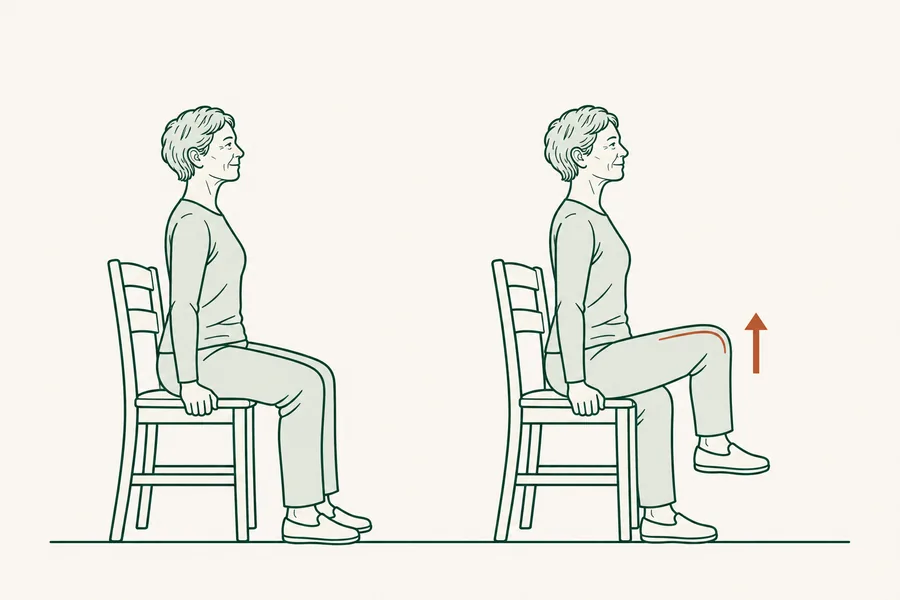
Sit tall and hold the sides of the chair if you need support. Lift one knee while keeping it bent. Set that foot down gently, then lift the other knee. For this starter routine, try one set of five lifts on each side. Easier. Lift each foot only a little. Harder. Hold each knee up for 5 seconds before lowering it. [1][7]
Ankle circles
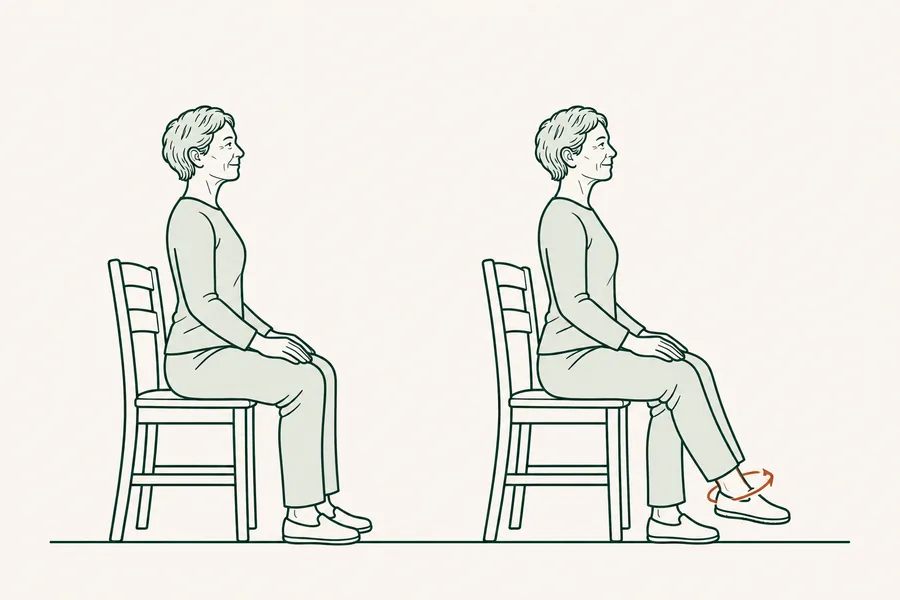
Sit with both feet flat to start. Lift one foot and slowly circle your ankle in both directions. Switch feet. Keep the circles small if that feels more comfortable. [9]
Heel-toe raises
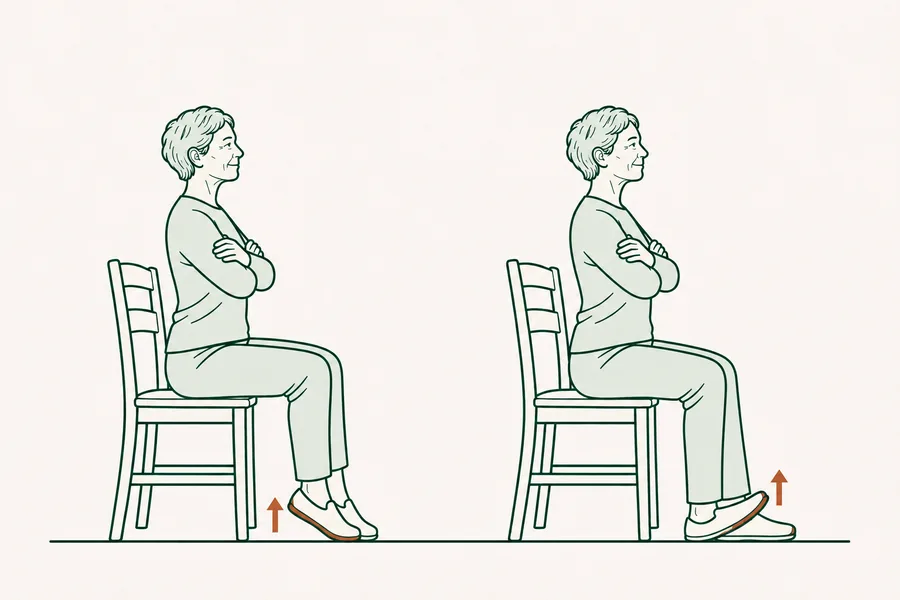
Start with both feet flat. Lift both heels, then lower them. With both heels down, lift and lower the toes of one foot at a time. For this starter routine, try five heel raises and five toe raises per foot. Easier. Lift your heels and toes a shorter distance. [7][8]
Seated knee extensions
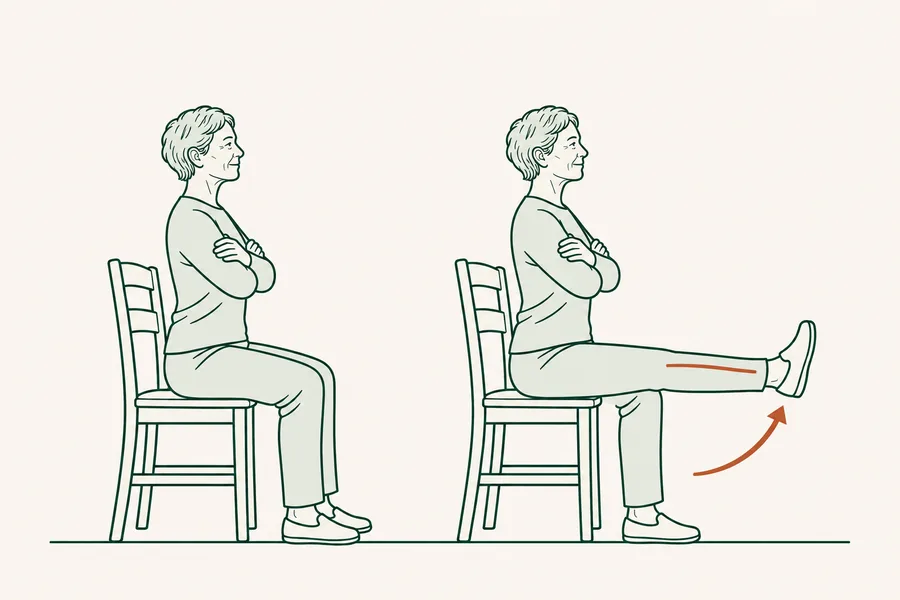
Start with both feet flat. Slowly straighten one knee so your foot moves out in front of you. Hold for about 3 seconds, then lower your foot with control. For this starter routine, try one set of five repetitions on each leg. Easier. Straighten your knee partway. Harder. As you get stronger, hold the straightened position for 5 to 10 seconds. [7]
Sit-to-stand
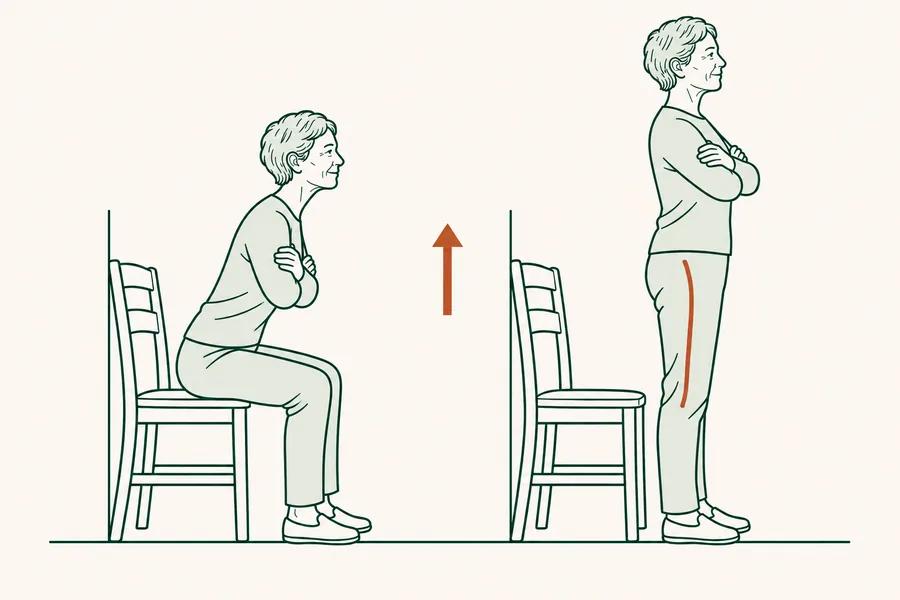
Place a sturdy chair against a wall. Sit toward the front with your feet flat and about hip-width apart. Lean slightly forward, press through both feet, and stand tall. Bend at your hips and knees to lower yourself back into the chair slowly. Try 5 repetitions. Easier. Use firm armrests if they let you rise and sit with control. Harder. Cross your arms over your chest if you can rise and sit steadily without hand support. If standing feels unsafe or you need another person’s help to stand or sit, do seated knee extensions instead. [2][7][9][23]
Upper-body strength exercises
Seated row with a resistance band
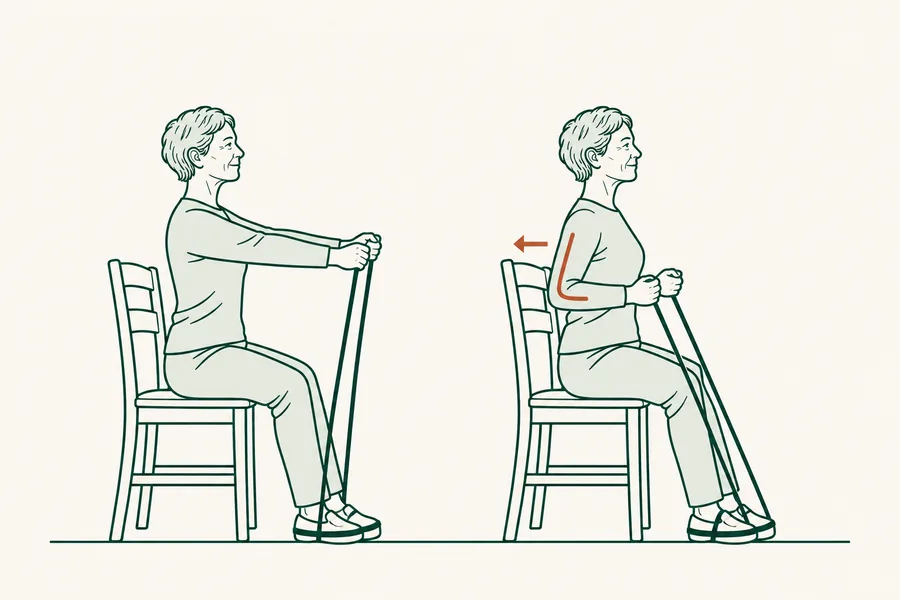
Sit tall. Follow your band’s instructions for a seated row and check for tears or worn spots before use. Use the foot setup only if the manufacturer shows how to secure the band under your shoes. Skip the band if you cannot secure it or it starts to slip. With the band secured, hold one end in each hand. Pull your elbows back close to your sides so your hands move toward your waist. Slowly let your arms come forward to release the tension after each pull. Do 5 to 10 repetitions. Easier. Start with a lighter band. Harder. Increase the resistance gradually once you can pull and release smoothly. [10][11][21]
Wall push-up
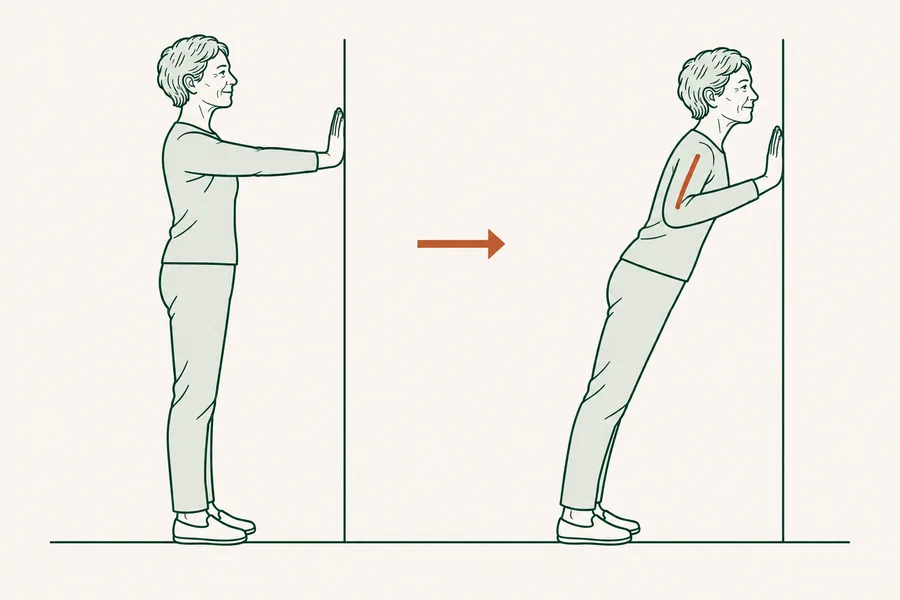
Stand facing a wall with your feet about hip-width apart. Put your palms flat on the wall around shoulder height. Bend your elbows to bring your chest toward the wall, then press back to the start. Keep your body straight as you move. Start with 5 repetitions. Easier. Stand closer to the wall. Harder. If you can stay steady and complete five repetitions comfortably, gradually work up to 10. If standing feels unsafe, try the seated forward reach below the routine table as an easy movement break. [2][7][9]
Seated overhead reach
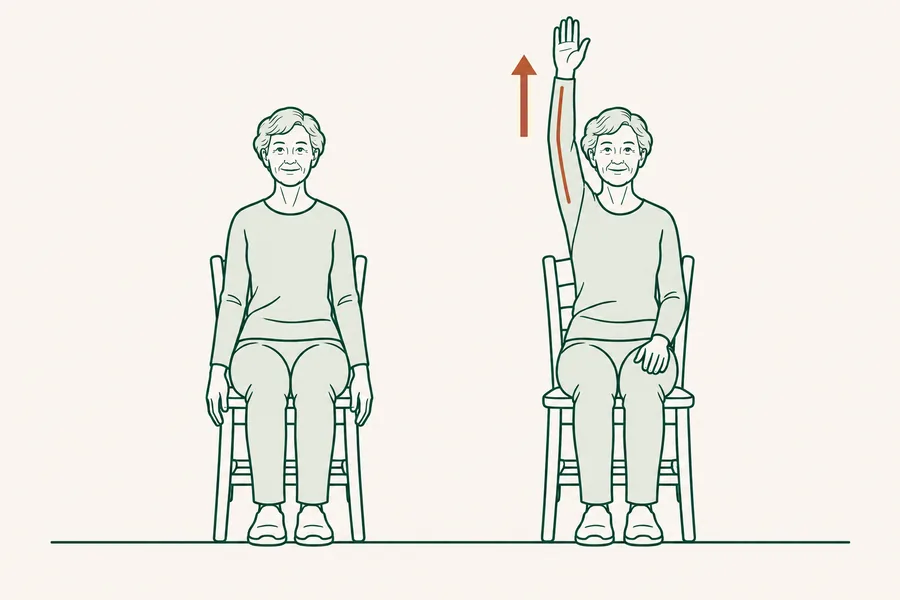
Sit upright with both feet flat. Slowly raise one hand overhead as far as you can comfortably, then lower it and switch arms. Use a smaller reach if needed. Skip this movement if it causes shoulder pain. [18][25]
Gentle movements, stretches, and breathing
Seated torso twist
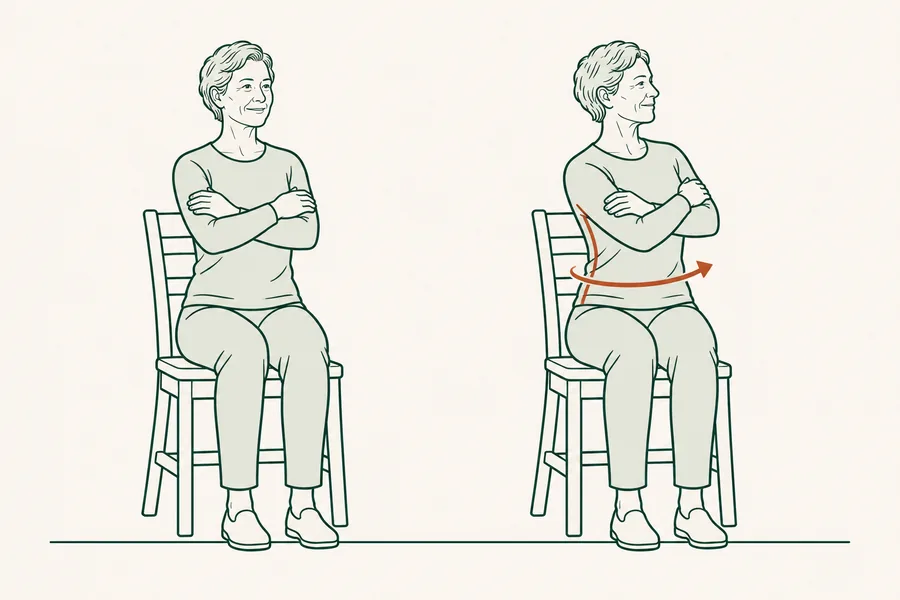
Sit tall with your feet flat. Cross your arms over your chest and keep your hips facing forward. Turn your upper body gently to one side, hold for 5 seconds, and return to the center. Repeat on the other side. Work up to 5 turns per side. Keep the turn small, slow, and comfortable. If you’ve had a spinal fracture or have been told you’re at high risk of one, ask a physical therapist which twists and bends are suitable for you. [1][22]
Seated side bends
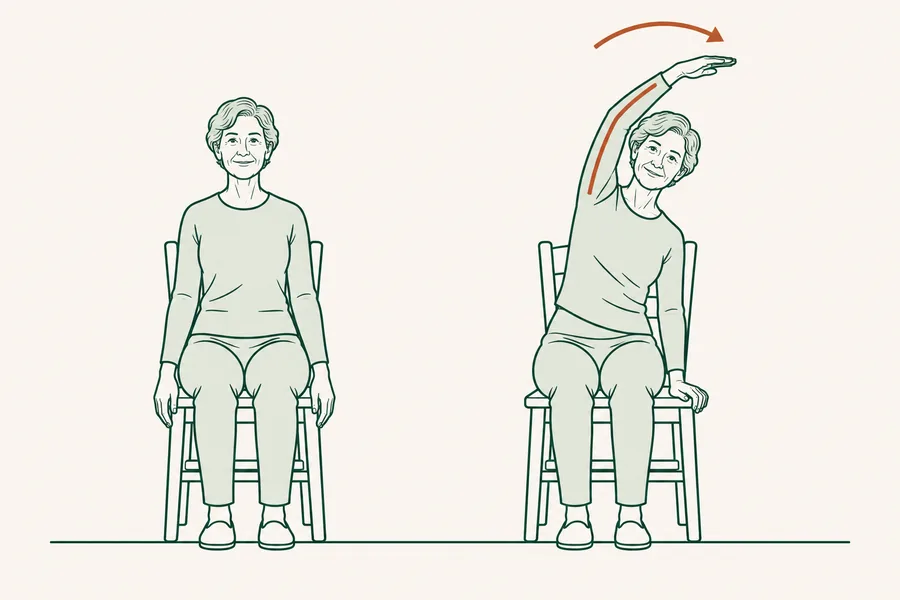
Sit upright with both feet flat. Raise one arm overhead and lean gently toward the opposite side. Hold briefly, return to the center, and switch sides. Keep the bend small and comfortable. Keep both arms down if reaching overhead is uncomfortable. [26]
Seated hamstring stretch
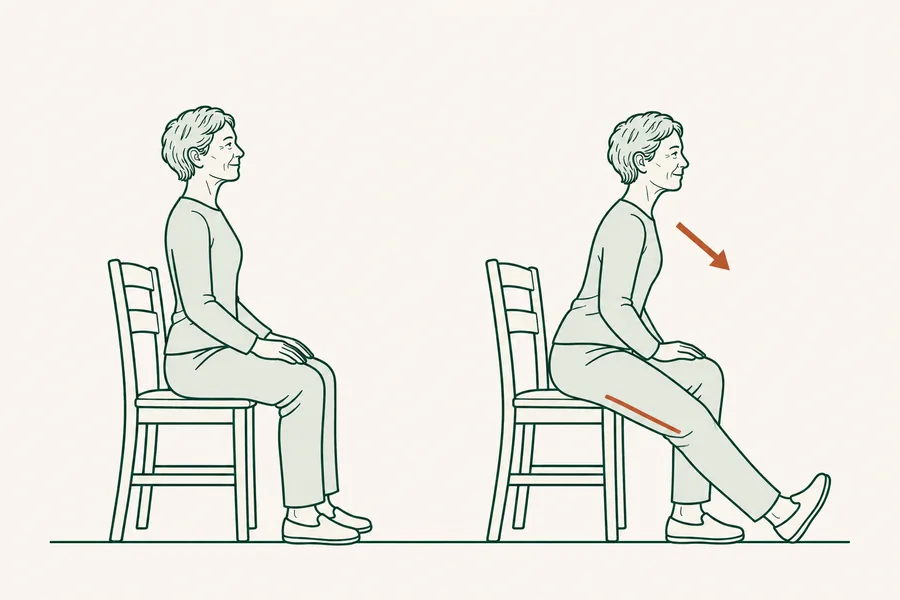
Sit toward the front of the chair. Slide one heel forward until the leg is straight. Rest that heel on the floor and keep the other foot flat. Keep your back straight and lean forward slightly from the hips until you feel a gentle stretch in the back of your thigh. Hold briefly while breathing normally, then switch legs. Ease off if you feel pain or tingling. [18][27]
Chest stretch
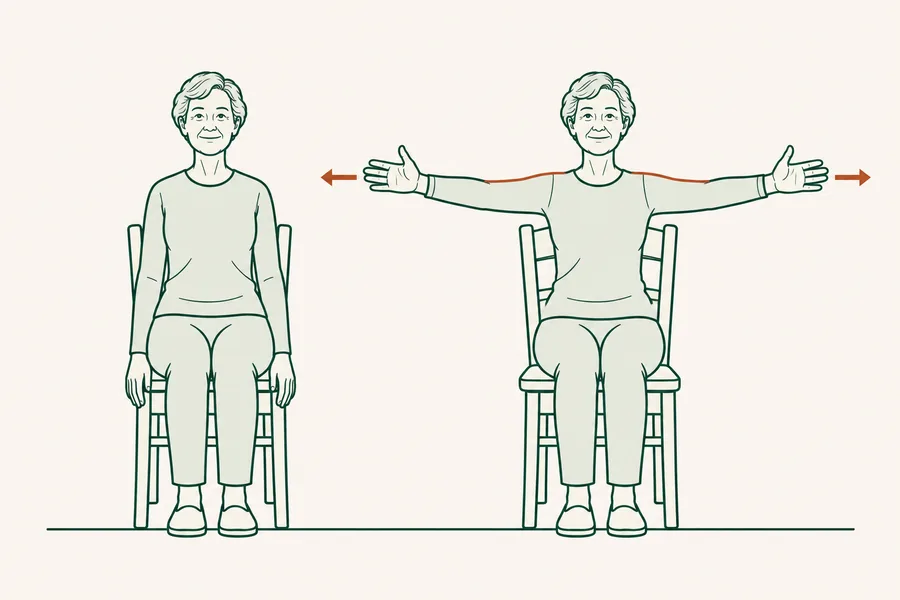
Sit tall, let your shoulders settle down and back, and open your arms out to the sides. Lift your chest slightly until you feel a gentle stretch across it. Hold for 5 to 10 seconds, then relax. Repeat 5 times. Easier. Keep your arms lower and open them only as far as feels comfortable. Harder. Work toward the longer end of the hold while keeping the stretch gentle. [1]
Finish with gentle breathing
Sit with your back supported and your feet flat. Relax your shoulders. If it feels comfortable, breathe in gently through your nose and out through your mouth. Count only if it helps you stay relaxed, and let your breathing return to its usual rhythm if counting feels uncomfortable. [13]
For this sample routine, finish with about a minute of quiet, comfortable breathing.
The 10-minute and 15-minute chair exercise routines
Use the table as a menu for a light 10- or 15-minute session. Move slowly and rest as needed. If a section lists more exercises than you can comfortably finish, choose fewer and save the rest for another day. If you do moderate or vigorous aerobic exercise, allow 5 to 10 minutes to ease in and another 5 to 10 minutes to slow down afterward. [7][24]
| Part of the routine | 10-minute version | 15-minute version |
|---|---|---|
| Warm-up [7][9] | About 2 minutes. Easy seated marching, shoulder rolls, and heel-toe raises. | About 2 minutes. Use the same warm-up. |
| Legs and ankles [7][9] | About 3 minutes. Choose from knee extensions, ankle circles, and sit-to-stands if you can stand steadily. | About 4 minutes. Choose from ankle circles, heel-toe raises, knee extensions, and sit-to-stands if you can stand steadily. |
| Upper body [2][10][25] | About 2 minutes. Choose a seated row or wall push-up. For an easy movement break, try a seated forward reach. | About 4 minutes. Choose from a seated row, wall push-up, seated forward reach, and seated overhead reach. |
| Mobility and cool-down [1][13][26][27] | About 3 minutes. Choose a chest or hamstring stretch and finish with gentle breathing. | About 5 minutes. Choose from torso twists, side bends, hamstring stretches, and chest stretches. Finish with gentle breathing. |
For a seated forward reach, sit tall and slowly reach one hand forward within a comfortable range. Bring it back and switch arms. Try up to five reaches per arm as an easy movement break. You can also rehearse the row motion with empty hands. For seated upper-body strengthening, choose an exercise with resistance you can move with control. [10][11]
How chair exercise fits into your week
U.S. guidelines recommend that adults 65 and older get at least 150 minutes of moderate aerobic activity a week, 75 minutes of vigorous aerobic activity, or an equivalent mix. They also recommend muscle-strengthening activity at least 2 days a week and balance activity each week. Strength work should cover all the major muscle groups. If a health condition makes the aerobic target difficult, be as active as your abilities and health allow. [14][15]
A resisted seated row and controlled sit-to-stands can count as strength work when the last few repetitions feel challenging and you can still move safely. For aerobic minutes, use steady, rhythmic movement that raises your breathing and heart rate. At moderate effort, you can usually talk but would have trouble singing. [11][14]
Sit-to-stands strengthen muscles you use to get up from a chair. Include balance exercises suited to your abilities as part of your weekly activity. If you feel unsteady when you get up or walk, ask a physical therapist to help you choose balance exercises and show you what to hold for support. [9][12][15]
Frequently asked questions
Can I do chair exercises if I’m over 70?
Yes. Choose moves based on how steadily and comfortably you can do them. Start with seated movements if getting up is difficult, and use fewer repetitions or a smaller range as needed. If you’ve had a recent fall or aren’t sure what’s safe, ask your doctor or physical therapist where to start. [1][7][12][15]
Is a 10-minute chair workout worth doing?
Yes. A short session can help you start moving again after time away from exercise. Short bouts of moderate aerobic activity count toward your weekly total. A chair session focused on strength and gentle movement can also be useful on its own. [11][14]
What kind of chair should I use for seated exercise?
Use a sturdy chair without wheels that lets both feet rest flat on the floor. If you need to push off with your hands to stand, choose a chair with firm armrests. If your rollator has a seat, follow the instructions for your model. Use the seat only on firm, level ground with both parking brakes locked. Use a stationary chair for these exercises. [1][2][9][16][28]
Where can I find free chair exercise videos for seniors?
The NHS offers a chair-based workout video and short demonstrations of moves such as a wall push-up. The VA offers a 12-minute tai chi lesson with seated and standing options. Choose the seated option if standing feels unsteady. Preview the video first so you know whether it includes standing moves. [17][18][19]
Can I do tai chi in a chair?
Yes. The VA demonstrates tai chi with seated and standing options. Seated tai chi lets you practice slow, controlled movement while sitting. If your goal is steadier standing or walking, ask a physical therapist which balance exercises fit your abilities. [12][15][19]
This guide is for general information. Ask your doctor or physical therapist for advice about exercising with your health conditions.
Sources
- NHS. Sitting exercises. https://www.nhs.uk/live-well/exercise/sitting-exercises/
- NHS. Strength exercises. https://www.nhs.uk/live-well/exercise/strength-exercises/
- Leicestershire Partnership NHS Trust. Preventing Falls. https://www.leicspart.nhs.uk/wp-content/uploads/2019/02/U0775-Preventing-Falls-leaflet-Update-04.pdf
- U.S. Department of Health and Human Services. Stay Active As You Get Older. https://odphp.health.gov/myhealthfinder/health-conditions/obesity/stay-active-you-get-older-quick-tips
- U.S. Department of Veterans Affairs. Preventing Falls Education Resource Guide. https://www.patientsafety.va.gov/docs/fallsToolkit/Education_Resource_Guide.pdf
- American Heart Association. Warning Signs of a Heart Attack. https://www.heart.org/en/health-topics/heart-attack/warning-signs-of-a-heart-attack
- North Tees and Hartlepool NHS Foundation Trust. Chair Exercises. https://www.nth.nhs.uk/resources/chair-exercises/
- University Hospitals Sussex NHS Foundation Trust. Chair Exercises. https://www.uhsussex.nhs.uk/wp-content/uploads/2025/06/2545-chair-exercises-2025.pdf
- Kingston and Richmond NHS Foundation Trust. Home Exercise Programme for Falls Prevention. https://www.kingstonandrichmond.nhs.uk/patients-and-families/patient-leaflets/home-exercise-programme-falls-prevention
- Gloucestershire Hospitals NHS Foundation Trust. Simple exercises to encourage weight loss. https://www.gloshospitals.nhs.uk/your-visit/patient-information-leaflets/simple-exercises-encourage-weight-loss/
- CDC. What Counts as Physical Activity for Older Adults. https://www.cdc.gov/physical-activity-basics/adding-older-adults/what-counts.html
- North Tees and Hartlepool NHS Foundation Trust. Balance Exercises. https://www.nth.nhs.uk/resources/balance-exercises/
- NHS. Breathing Exercises for Stress. https://www.nhs.uk/mental-health/self-help/guides-tools-and-activities/breathing-exercises-for-stress/
- U.S. Department of Health and Human Services. Current Physical Activity Guidelines. https://odphp.health.gov/our-work/nutrition-physical-activity/physical-activity-guidelines/current-guidelines
- CDC. Older Adult Activity Overview. https://www.cdc.gov/physical-activity-basics/guidelines/older-adults.html
- West Lothian Health and Social Care Partnership. Equipment Information Sheets, including the Walking Rollator manual. https://westlothianhscp.org.uk/article/71700/Equipment-Information-Sheets
- NHS. Chair-Based Pilates Video Workout. https://www.nhs.uk/live-well/exercise/pilates-and-yoga/chair-based-pilates-exercise-video/
- NHS. Strength and Flex Exercise Plan Videos. https://www.nhs.uk/live-well/exercise/strength-and-flex-exercise-plan-how-to-videos/
- U.S. Department of Veterans Affairs. Live Whole Health, Seated and Standing Tai Chi. https://news.va.gov/124830/live-whole-health-190-are-you-sitting-down/
- CDC. Signs and Symptoms of Stroke. https://www.cdc.gov/stroke/signs-symptoms/index.html
- Published case series on resistance-band eye injuries. https://pmc.ncbi.nlm.nih.gov/articles/PMC9612684/
- Osteoporosis exercise consensus on physical activity and exercise for people with osteoporosis or vertebral fracture. https://pmc.ncbi.nlm.nih.gov/articles/PMC5101068/
- CDC. STEADI Compendium of Effective Fall Interventions. https://www.cdc.gov/falls/pdf/Steadi_Compendium_2023_508.pdf
- American Heart Association. Warm Up, Cool Down. https://www.heart.org/en/healthy-living/exercise-and-physical-activity/fitness-basics/warm-up-cool-down
- University Hospitals Sussex NHS Foundation Trust. Chair Exercises with Seated Arm Exercises. https://www.uhsussex.nhs.uk/resources/chair-exercises-with-seated-arm-exercises/
- HealthLink BC. A Program of Seated Exercises. https://www.healthlinkbc.ca/healthwise/program-seated-exercises
- Shropshire Community Health NHS Trust. Seated hamstring stretch. https://www.shropscommunityhealth.nhs.uk/content/doclib/13864.pdf
- NHS. Walking aids, wheelchairs and mobility scooters. https://www.nhs.uk/social-care-and-support/care-services-equipment-and-care-homes/walking-aids-wheelchairs-and-mobility-scooters/
This guide is general information, written from the sources listed above and checked for accuracy in November 2026. It does not replace advice from your own doctor or pharmacist.