Balance and strength exercises for older adults
Balance exercises for seniors, such as supported weight shifts and heel-to-toe standing, can help you practice staying steady. Add leg-strengthening moves such as sit-to-stands and heel raises, and use a sturdy counter for support as you build up. If you’ve fallen, often feel dizzy, or struggle to walk safely, talk with your doctor or a physical therapist before starting on your own. [1] [2] [3]
Why balance can change with age
Staying upright takes teamwork. Your eyes, inner ear, and sense of where your feet are all send signals to your brain. Your muscles respond to those signals when you turn, step off a curb, or catch yourself after a stumble. Changes in vision, sensation, or muscle strength can make those adjustments harder. [1] [4]
Some medicines can cause dizziness or sleepiness. Inner-ear problems can make it feel as if the room is spinning, and a drop in blood pressure can make you feel lightheaded when you stand. If you’re helping a parent, ask what they feel and when it happens. Feeling faint after getting out of bed is a different clue from feeling unsteady when turning. Share those details with their doctor, and ask a doctor or pharmacist to review any medicines that might be involved. [1] [4]
Two simple checks for leg strength and balance
CDC’s STEADI program uses these checks to help identify fall risk. They can give you and your clinician a starting point for a conversation. A score alone cannot tell you why you feel unsteady. Have a clinician administer both checks and stay beside you for safety. Keep using your usual cane or walker in daily life. The four-stage test is scored without a cane or walker, so if you need one to stand safely, ask your clinician to choose a safe way to assess your balance. [5] [6]
30-second chair stand
This checks how well your legs handle repeated trips from sitting to standing. The CDC setup uses a straight-backed chair with no armrests, a seat about 17 inches high, and a timer. [5]
- The clinician asks you to sit in the middle of the seat with both feet flat and your back straight. They ask you to cross your wrists, place each hand on the opposite shoulder, and keep your arms against your chest. [5]
- When timing starts, the clinician asks you to stand all the way up and sit down again, repeating for 30 seconds. If you need to push with your arms, the clinician stops the test and records a zero. [5]
- The clinician counts each full stand. If you’re more than halfway up when time ends, they count that last attempt. The CDC sheet has reference scores by age and sex that the clinician can use to interpret your result. [5]
4-stage balance test
In the CDC test, the clinician helps you get into each position, then lets go and stays close. You keep your eyes open. Each position lasts up to 10 seconds. The clinician ends the test at the first position you cannot hold for 10 seconds without moving your feet or needing support. [6]
| Stage | Foot position |
|---|---|
| 1 | Stand with your feet side by side. [6] |
| 2 | Put one foot a little ahead so its inner arch touches the big toe of the other foot. [6] |
| 3 | Put one foot directly in front of the other, with the front heel touching the back toes. This is a tandem stand. [6] |
| 4 | Stand on one foot. [6] |
The CDC considers a tandem stand of less than 10 seconds a sign of increased fall risk in older adults. Bring that result, or any trouble with the chair stand, to your doctor or physical therapist. When you practice balance as exercise, use the counter for support. The test has its own rules for scoring. [2] [5] [6]
Start with support and build up slowly
Clear the floor around a fixed kitchen counter and wear well-fitting shoes. For standing exercises, start with both hands on the counter if you need them. For chair exercises, use a solid chair that stays in place, with your feet flat on the floor. For step-ups, use a fixed step with a handrail. [2] [3] [4] [7]
Begin with the movements you can do slowly and with control. Supported weight shifts let you keep both feet flat. For heel raises, hold the counter with both hands as you lift your heels, keeping the balls of both feet on the floor. A tandem stand narrows your base, and a heel-to-toe walk adds movement. Keep the amount of hand support you need to move steadily. Try a lighter touch only after you can repeat the movement with control at your current level, and keep the counter within reach. Stop any movement that causes or worsens pain. [2] [3] [7] [8]
Stop exercising if you feel dizzy, have chest pain, or become severely short of breath. In the U.S., call 911 for new chest pain, severe shortness of breath, or possible stroke symptoms such as sudden trouble walking or loss of balance, even if the symptoms improve. If you feel lightheaded without emergency symptoms, sit somewhere safe and contact your clinician before resuming exercise. [2] [16] [17]
Balance exercises for seniors to practice at home
1. Weight shifts
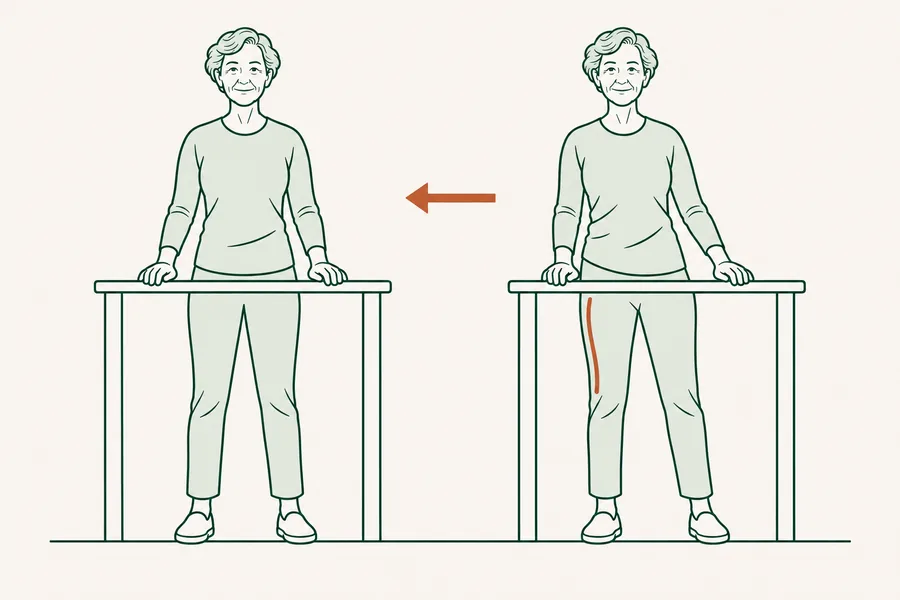
Hold the counter and stand with your feet a little wider than your hips. Slowly shift your weight onto your right leg while keeping both feet down. Come back to the middle, then shift toward your left. Let your body move over the supporting leg without bending sideways at the waist. Keep the shift small if moving farther makes you feel unsteady. [2]
2. Tandem stand
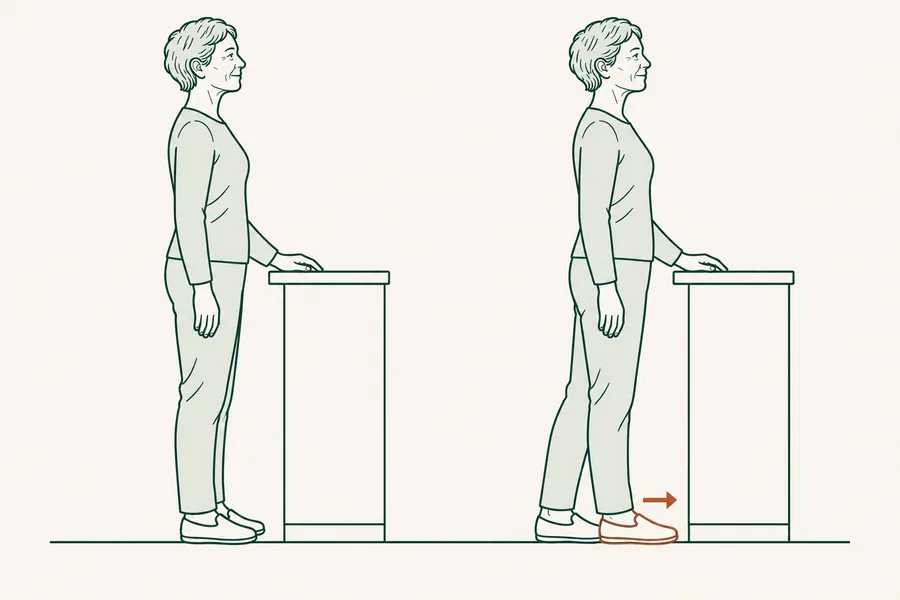
Stand beside the counter with a hand on it. Slide one foot ahead of the other. Start with the feet slightly offset if you need a wider base. When that feels steady, line up the front heel with the back toes. Hold briefly, step back to your usual stance, and switch which foot is in front. Keep your gaze forward. [2] [6]
3. Single-leg stand
Face the counter and hold on. Shift your weight onto one foot and lift the other just off the floor. Keep your hips level and the knee you’re standing on slightly bent. Lower the lifted foot gently and change sides. The NHS suggests working toward a hold of 5 to 10 seconds, 3 times on each side. Use a shorter hold if you need it. [2] [7]
4. Heel-to-toe walk
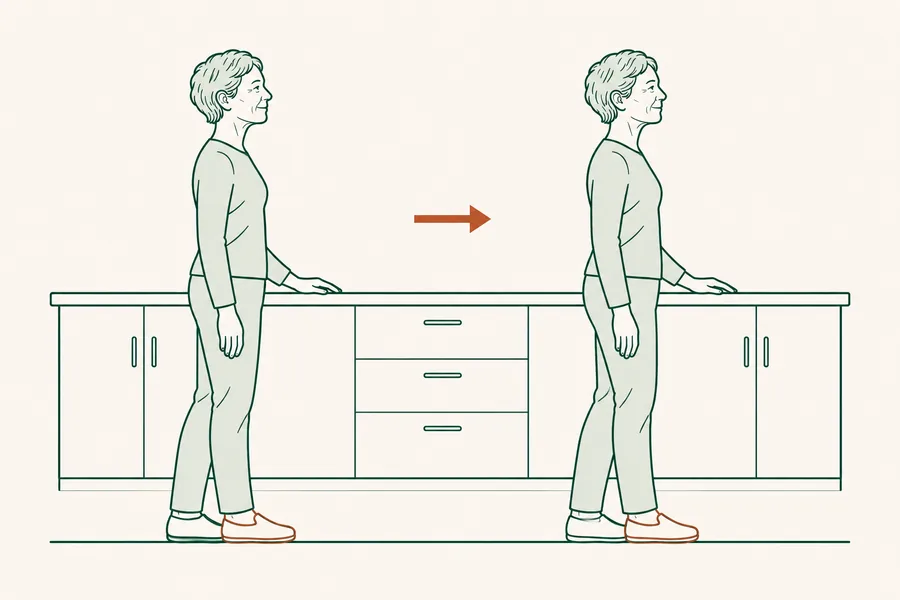
Stand alongside a clear stretch of counter so your hand can follow it as you move. Place one heel just in front of the toes of your other foot. Bring the back foot forward and repeat. Look ahead and move slowly. Work toward 5 controlled steps where you have continuous support. [2] [7]
Leg-strengthening exercises for everyday movement
These moves work muscles you use when you get out of a chair, go up a step, or steady yourself while standing. Build the number of repetitions gradually, keeping each movement slow enough to control. [3] [7] [8]
5. Heel raises
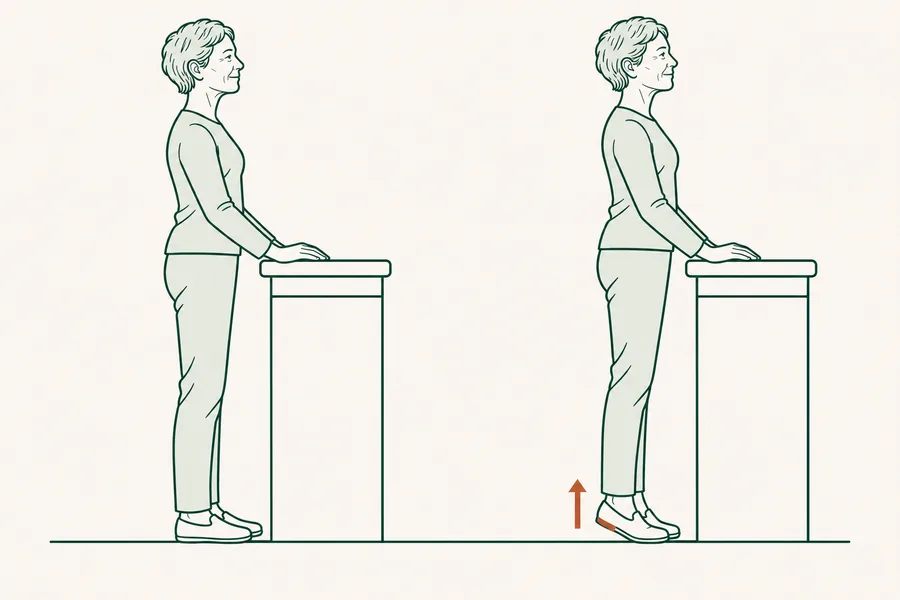
Face the counter with both hands resting on it and your feet flat. Slowly lift both heels so your weight moves onto the balls of your feet. Rise only as far as you can comfortably, then lower your heels slowly. Start with 5 repetitions. [2] [3]
6. Sit-to-stand
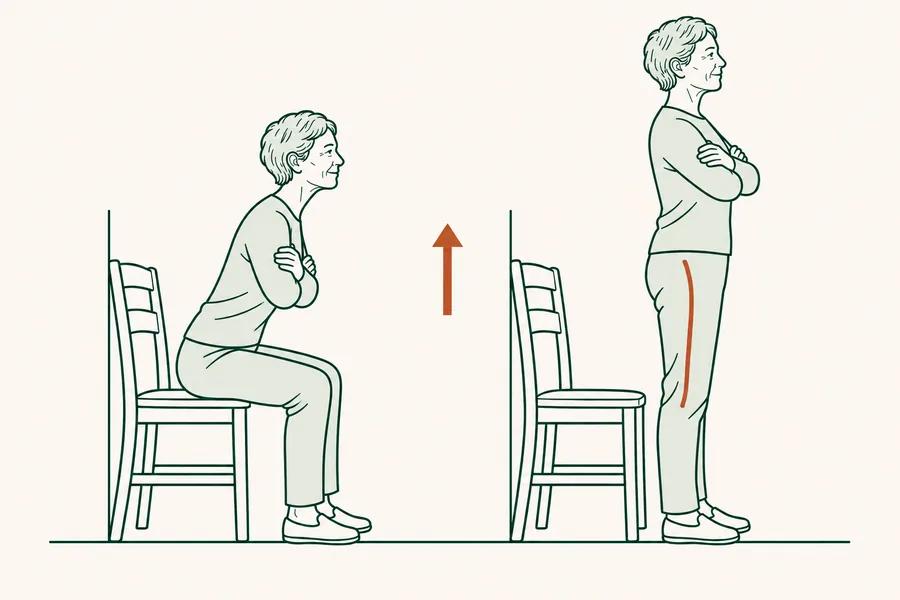
Sit toward the front of a sturdy chair with both feet flat. Lean forward a little, press through your feet, and stand tall. Bend at your hips and knees and lower yourself slowly back into the seat. Use the armrests if you need help. As standing gets easier, try using less help from your arms. [3] [8]
7. Side leg raise
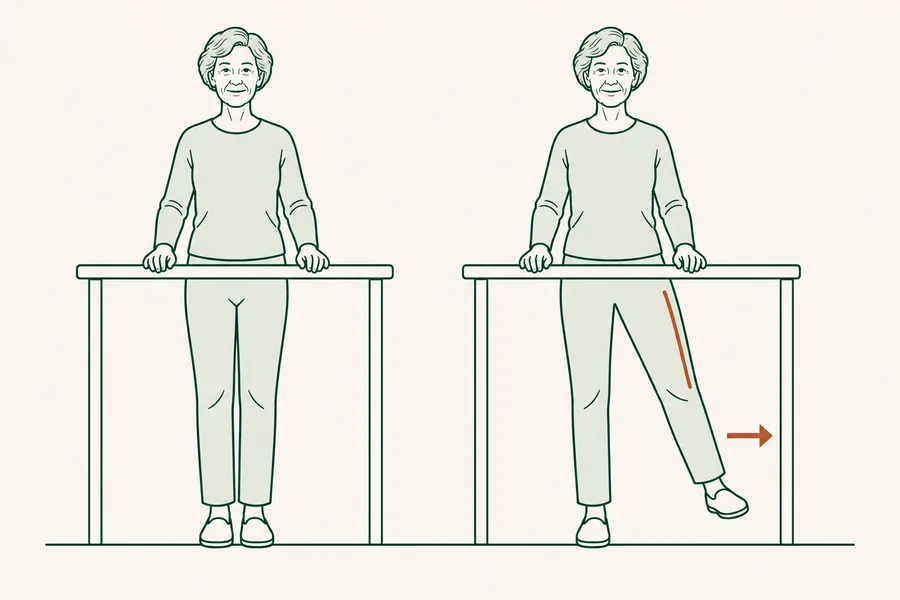
Face the counter and hold on. Stand tall and lift your right leg out to the side as far as is comfortable. Keep your hips facing forward and avoid leaning as the leg lifts. Lower your foot slowly, then change sides. The NHS suggests 5 lifts on each side. [2] [3]
8. Back leg raise
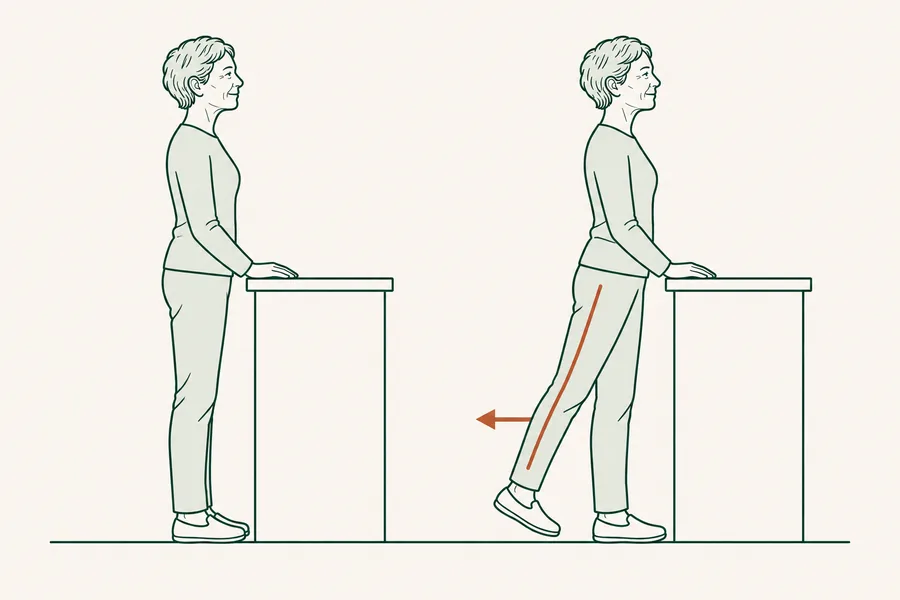
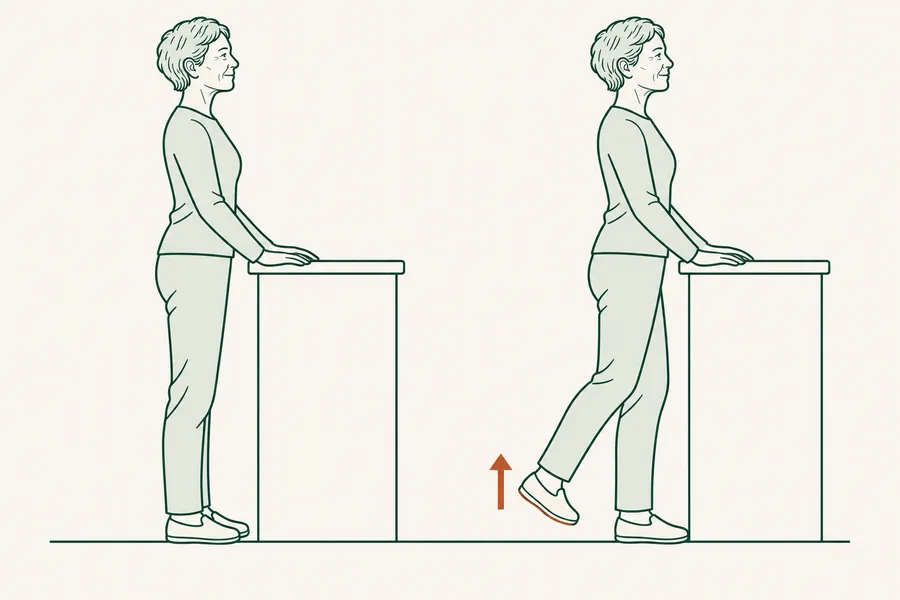
Hold the counter and stand upright. Move one leg a short distance behind you while keeping it straight. Use a small lift so your lower back stays steady without arching. Bring the foot back down and repeat on the other side. The NHS suggests up to a 5-second hold and 5 lifts on each side. You should feel the effort around your buttock and the back of your thigh. [3]
9. Step-ups
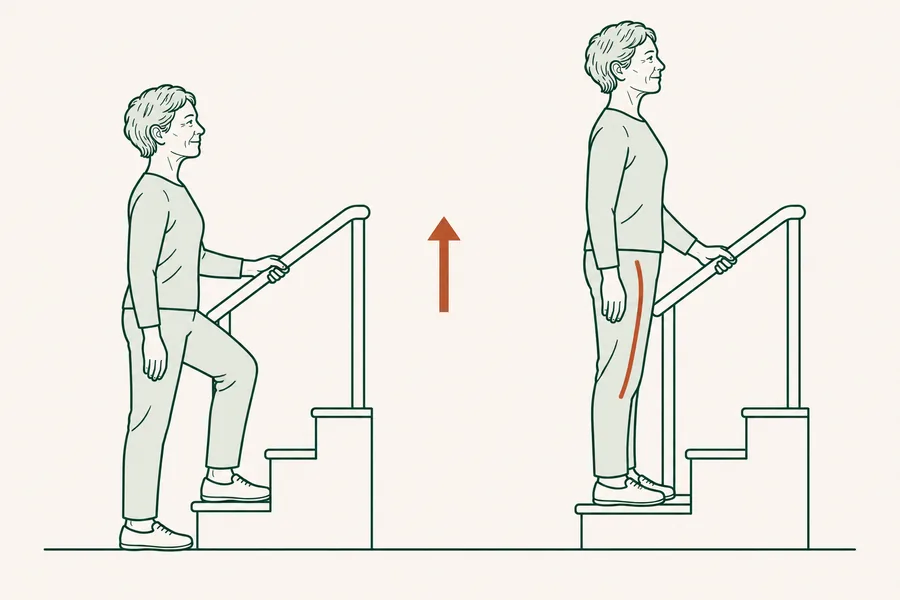
Face a fixed step and hold the handrail. Put your right foot on the step, press through that foot, and bring your left foot up beside it. Step back down slowly, one foot at a time. Switch which leg leads. The NHS suggests working up to 5 step-ups with each leg leading. [7]
Tai chi basics and what the evidence shows
10. Tai chi classes for balance
Tai chi programs for older adults use controlled weight shifts and coordinated movements. If you want to try tai chi, look for a beginner class for older adults. If you’ve fallen or need help standing safely, ask a physical therapist which class or adaptations would suit you. [9] [10] [12]
A 2019 Cochrane review found that older adults in tai chi programs were about 20% less likely to fall at least once than those in comparison groups. The evidence for that finding was strong. The review also found that tai chi may lower the overall rate of falls, though the evidence for that measure was less certain. These findings came from studies of older adults living in the community who took part in tai chi programs. [10]
The Otago Exercise Program is a home-based fall-prevention program that combines leg strengthening, balance practice, and walking. A physical therapist can choose the starting level and adjust the exercises as you improve. In a one-year trial of older adults at high risk who sought medical care after a fall, the home program delivered by a physical therapist plus usual care reduced the rate of falls compared with usual care alone. About the same number of people fell at least once in each group. [11]
How often to work on balance and strength
For older adults living in the community, international fall-prevention guidelines recommend at least 3 sessions a week that include exercises that challenge balance and practice everyday movements such as standing from a chair and stepping. The guidelines call for a program tailored to the person that gets gradually harder over at least 12 weeks and continues beyond that for greater benefit. Start at a level you can manage safely and build from there. [12]
U.S. guidance recommends weekly balance activity and muscle strengthening on 2 or more days for adults 65 and older. The weekly aerobic target is at least 150 minutes of moderate activity such as brisk walking, 75 minutes of vigorous activity, or an equivalent mix. If you have trouble meeting these targets, be as active as your health and abilities allow. Balance and strength can fit into the same session. The leg exercises here cover part of a strength routine. The U.S. guidance also calls for working the other major muscle groups, including the back, abdomen, chest, shoulders, and arms. [13]
When to see a physical therapist
Tell your doctor about any fall. If you hit your head in a fall, get medical care right away, especially if you take a blood thinner. Ask about a physical therapy evaluation if you’ve fallen, often feel unsteady walking or turning, or have cut back on daily activities because you worry about falling. [1] [4] [12] [18]
A physical therapist can watch how you get out of a chair, walk, and turn, then teach exercises that match what gives you trouble. They can also help you learn to use a cane or walker safely. [1] [4] [12]
If dizziness or a spinning feeling keeps coming back, tell your doctor what brings it on and how long it lasts. If it comes from an inner-ear problem, your doctor may refer you to a physical therapist trained in vestibular rehabilitation, which uses exercises tailored to dizziness and balance symptoms. [1]
Frequently asked questions
What is the best balance exercise for seniors?
Start with a move you can control while holding a counter. Weight shifts let you practice with both feet down. As you get steadier, a tandem stand or a supported heel-to-toe walk gives you a harder task. A physical therapist can help you choose a starting point if you’ve fallen or feel unsure on your feet. [2] [12]
Where can I find a printable balance exercise PDF for seniors?
The STRIDE fall-prevention study has a printable, illustrated exercise worksheet. If you’ve fallen or need help standing safely, ask a physical therapist to mark which exercises and support levels to use. See My Exercise Plan for Strength and Balance (PDF). [2] [12]
Is there a balance exercise video for seniors on YouTube?
The Chartered Society of Physiotherapy has a video that demonstrates supported moves, including heel raises, sit-to-stands, and heel-to-toe walking. The video and written instructions are on its strength and balance exercise page. [8]
What exercise helps strengthen the lower back for seniors?
A bridge is one option a physical therapist may teach. Lie on your back with your knees bent and your feet flat on the floor, about hip-width apart. Gently tighten your abdomen and buttocks, lift your hips only as high as you can control, then lower slowly. If you have back pain or trouble getting into that position, ask a physical therapist which back-strengthening exercises suit you. [14]
What is the best walker for seniors with balance problems?
The right walker depends on how much support you need and how safely you can lift, steer, or brake it. A standard walker offers the most stability but must be lifted to move it. A front-wheeled walker rolls forward while the back legs provide support. A four-wheeled walker, or rollator, can provide continuous balance support, but it is less stable than a standard walker. It may suit someone who can operate the brakes reliably and needs little or no help taking weight off a leg. Ask a physical or occupational therapist to check the fit and watch you use it. [4] [15] [19]
This page is for general information. Ask your doctor or physical therapist for advice about your symptoms and which exercises are safe for you. [1] [12]
Sources
- National Institute on Aging. Older Adults and Balance Problems
- STRIDE Study. My Exercise Plan for Strength and Balance (PDF)
- NHS. Strength exercises
- National Institutes of Health. Falls and Fall Prevention in Older Adults
- CDC STEADI. 30-Second Chair Stand assessment (PDF)
- CDC STEADI. The 4-Stage Balance Test (PDF)
- NHS. Balance exercises
- Chartered Society of Physiotherapy. Helping older people stay active at home
- CDC. Compendium of Effective Fall Interventions for Older Adults (PDF)
- Cochrane. Exercise for preventing falls in older people living in the community
- JAMA. Effect of a Home-Based Exercise Program on Subsequent Falls Among Community-Dwelling High-Risk Older Adults After a Fall
- Age and Ageing. World guidelines for falls prevention and management for older adults
- CDC. Older Adult Activity
- Cambridge University Hospitals NHS Foundation Trust. Back pain exercises
- Mayo Clinic. Tips for choosing and using walkers
- American Heart Association. Heart Attack and Stroke Symptoms
- CDC. Signs and Symptoms of Stroke
- CDC. Facts About Falls
- American Family Physician. Mobility Assistive Device Use in Older Adults
This guide is general information, written from the sources listed above and checked for accuracy in November 2026. It does not replace advice from your own doctor or pharmacist.